

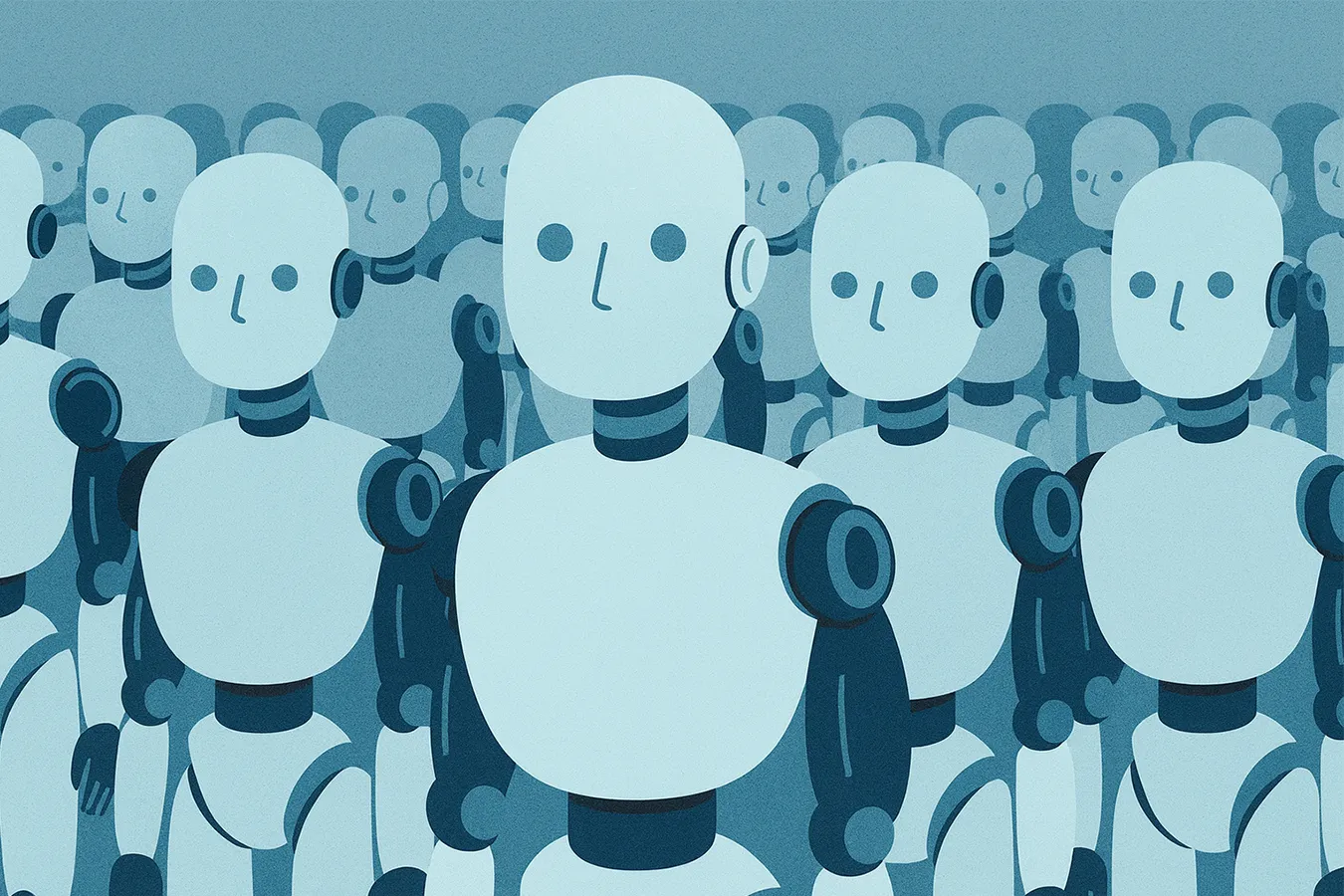
For the past few months, the idea that AI would allow for greater production while reducing the need for human skills has become widespread. It now influences decisions, recruitment, and internal trade-offs. But does this perception truly reflect what is happening within organisations?
Will AI really replace jobs?
On LinkedIn, one example follows another. The same demonstrations, the same chains of automation, the same exaltation around content multiplied at high speed to replace human intervention.
 This type of publication - which has become almost a genre in itself - is a perfect illustration of the shift at work. As for the figures relayed in the public debate, they do nothing but fuel this imagination. As we were recently reminded Yann Ferguson, sociologist specialising in employment and AI, One analysis estimates that one in two jobs could be profoundly transformed by artificial intelligence, and that one in ten jobs could see its share of tasks significantly reduced. And this is where the real misunderstanding arises: transformation has never meant replacement, and reducing tasks has never meant losing value. He's only saying that the nature of work is changing, not evaporating.
Does automation really allow us to produce better?
A few months ago, during a presentation, I was shown how to generate a complete PowerPoint in just a few clicks. The «wow» factor was undeniable, but the content was much less so. One slide followed another: clean, aligned... but with no real intention. The whole thing looked more like a rapid assembly than a constructed thought. The visuals inserted automatically had no graphic coherence, and some were even distorted.
In these demonstrations, the fascination with the speed of AI takes on the appearance of a technological cult, with a real confusion between speed and quality. This misunderstanding has very little to do with it: since AI enables us to go faster, then it could enable us to do better, and since it enables us to produce more, then it could replace. But speed says nothing about accuracy, and quantity says nothing about value. An imaginary world is gradually being created in which productivity becomes an argument in itself, almost detached from what is really being produced.
When AI becomes a pretext for delaying decisions
This misunderstanding of AI has spread far beyond the web for some time and now permeates all levels of French and global organisations. There's a discourse that runs from the basement to the top: since AI means we can produce more, does it mean we can reduce human labour? It gives rise to the idea that technological acceleration could almost naturally reduce the number of human resources in companies.
The temptation is great to bring AI into the conversation as a final argument: «Let's wait and see what AI will replace». We see this in recruitment that freezes, job descriptions that are redefined ad infinitum, decisions that are put off. Perhaps the most disconcerting thing is that some organisations genuinely seem to believe in it. They don't take up this narrative just to pretend: they adopt it as a credible prospect, and then unease sets in. Not in AI itself, but in the ease with which we imagine that a technology could absorb the complexity of human work.
AI replacement: a strategic alibi?
This climate of ambiguity is further fuelled by the fact that some major groups have already begun to use AI as a reason for reorganisation. In recent months, several companies - Amazon, Goldman Sachs, Microsoft - have announced waves of redundancies, explaining that the automation made possible by artificial intelligence would make it possible to reduce certain jobs or restructure entire departments. These high-profile announcements reinforce the idea that the transformation will be primarily quantitative. That it would consist of «doing more with less», even if it means suggesting that technology would mechanically absorb human functions.
However, these decisions have less to do with a real demonstration of capacity than with strategic positioning: to demonstrate rapid modernisation, to reassure the markets or to prepare for internal trade-offs that have already begun. In other words: these announcements do not validate the disappearance of business lines, they merely validate the narrative power of AI in a tense economic context.
The effect produced by AI is very real: it sustains the belief that the movement is irreversible, that organisations that do not adapt will be lagging behind, and that AI will install a new standard of efficiency based above all on human reduction. In this landscape of budgetary and political uncertainty in France, doesn't AI provide a convenient narrative: a way of dressing up hesitation, justifying a slowdown, masking a postponed decision? A screen that is perhaps much more comfortable than reality.
Faced with the spectacular promises of AI, there is a great temptation to see it as a substitute, a shortcut, a way of lightening the load on human labour. On the surface, this is attractive, but it obscures the real challenge facing companies in the future: that of quality. Because tomorrow the question will not be who produces «the most» but who produces «the most just», and it is in this requirement that the real transformation will take place.