


Your organisation's website has been around for several years. The statistics show that traffic is stable or even growing, and everything looks good on paper. And yet the teams on the ground are expressing a disconnect: no real impact on business, no qualified leads, no requests for quotes, no relevant contacts.
This feeling of inefficiency is much more common than you might think, particularly for B2B showcase sites. The good news? It doesn't mean that an organisation's site is a failure or that it needs to be redesigned from scratch. It simply indicates a mismatch between what the site attracts and what is expected of it internally.
Why might a B2B website generate traffic but not conversions? Which indicators should be analysed? What role does a website actually play in a prospect's decision-making journey?
In this article, discover the main causes of a low conversion rate despite satisfactory traffic and the questions to ask yourself before taking corrective action.
Does your website attract the right visitors?
Traffic does not measure performance
A website with high traffic is not necessarily a successful one. Traffic measures exposure to an audience, not its relevance. Thousands of visitors may land on an organisation’s pages without any of them being genuinely interested in what it has to offer.
Why analyse keywords and landing pages?
Imagine an e-commerce site selling snow tyres. Most of its incoming visitors are young people without a driving licence, without a car and living in sunny regions. The site may get thousands of hits, but it won't sell anything. Is this nonsense? Well, that's exactly what happens when you measure performance solely in terms of traffic volume, without analysing the results. who visits and why. So the real question is not «how many people are coming? but why, what are their expectations and are they on target?
Does the intent of visitors match your sales cycle?
Visitors who are still exploring
Not all visitors are ready to become customers. Understanding their level of readiness allows for a more accurate interpretation of the website’s performance. An organisation’s website may therefore attract a majority of visitors in the exploratory phase who are seeking to understand a topic, comparing options, forming an opinion… This is not a problem in itself, but if the bulk of the traffic is at this stage, the website gives the impression of yielding no results. The volume of visits becomes misleading: it masks a mismatch between visitors' intentions and what the site can trigger.
Let's take the example of a prospect who is hesitating between several service providers for a project. He visits one organisation's website to understand the key features of its services. They go back, refine their ideas and consult their competitors. Weeks or months later, they come back to take action (or call directly). In the meantime, the site has played its part, but if we only measure immediate conversions, we could conclude that it is useless.
How to identify maturing prospects
First, analyse the relationship between the number of visits and engaging actions. Traffic that never progresses to more engaging content is often traffic that arrives too early in the journey.
Observe visitors over a long period: if visitors keep coming back, they are probably maturing prospects.
Finally, ask customers when they sign the contract: have they visited the organisation's site beforehand? This gives a true picture of the role of the site in the sales cycle.
Is your offer immediately understandable?
The pitfall of in-house jargon
A website often reflects very well how the company sees itself, but much less how it is understood from the outside: this is the «we know what we're doing» trap. The internal teams know what they do, why they do it and for whom, but the site sometimes struggles to make these elements obvious to someone discovering them for the first time.
In many cases, the website reuses internal logics (jargon, acronyms, business structuring) that are not very accessible to an external visitor. When a person arrives on a website, they are looking for a quick answer to the question: «Can this site help me in my specific situation?» If this answer is not clearly apparent within the first 10 seconds, the visitor hesitates and then leaves.
What role does the website actually play in the decision-making journey?
The website as a tool for reassurance
A website is not always consulted for immediate action: contact by email, request for a quote... Very often, the website is also used as a verification point. People come here for reassurance, to confirm an impression, and to validate an intuition born elsewhere (network, word-of-mouth, recommendation). A website doesn't always trigger an action, but it often influences the decision.
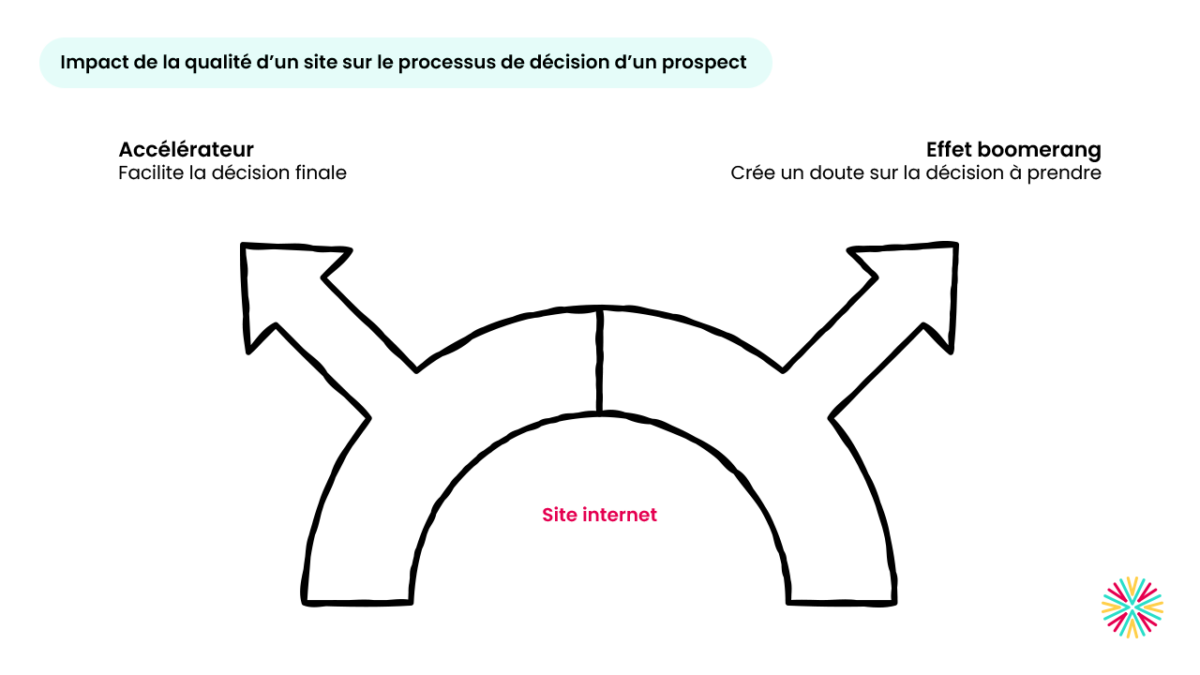
When this reassuring role of the website is fulfilled, the site acts as an invisible accelerator. When it doesn't, the effect is the opposite. A site that is vague, too generic, too marketing-oriented or badly aligned can have a boomerang effect: it creates doubts that will call into question the final decision. The site then becomes a form of silent customer reference: it doesn't trigger the action, but it makes it possible. In these cases, you might think that an organisation's website doesn't «make money», but it does play a decisive role: it reassures prospects or, on the contrary, makes them less credible.
The criteria that influence credibility
There are many criteria that prospects will judge when they visit a site. These range from technical consistency (fast loading time, fluid navigation, impeccable responsive design, absence of bugs, etc.) to editorial consistency (content in line with what is said elsewhere, level of language adapted to the target audience, spelling mistakes, etc.). It is difficult for the uninitiated to check all these criteria, but some can be checked by anyone. For others, only digital experts will be able to identify what might constitute a barrier.
In the majority of cases, the issue does not lie with the website itself, but with the discrepancy between its actual functioning and the strategic role attributed to it. A high-performing website is not measured solely by its traffic, but by its capacity to support decisions.