


You have invested in a website, an FAQ, a customer portal or a chatbot. Yet visitors still call to ask for a price, a delivery time, the status of a file or simply... how to do something. Faced with these queries, the first instinct is often to want to delete the telephone number: fewer calls means fewer queries for the teams. But is that really such a good idea?
Should you display a phone number on your website? Why do users still call despite online services? Which calls can you actually avoid? In this article, discover why the telephone remains essential and how to turn it into a lever for improving the customer experience rather than a channel to be eliminated.
Why display a phone number on your website?
Reassuring users
Displaying a telephone number on a website is primarily a way to reassure users. It indicates that in the event of doubt, a problem or a specific situation, a real person can take over. This presence is particularly important when a visitor has to make a significant decision: signing a contract, booking an expensive service, sending sensitive documents or choosing an offer that is difficult to compare. They are not always looking for additional information. Sometimes they simply want to verify that they will not be alone if something goes wrong.
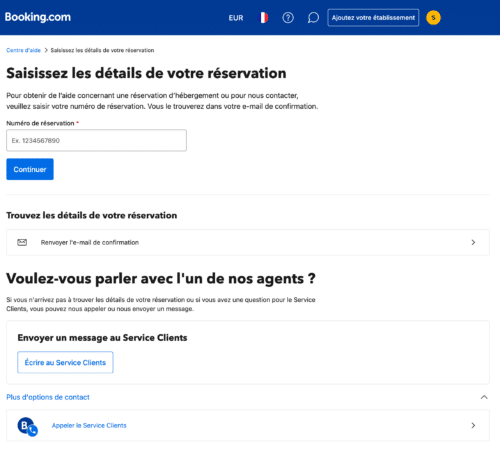
At Booking, although the phone number is positioned at the bottom of the page and is only accessible via an expandable tab, its presence contributes to user reassurance.
A visible phone number alone does not prove the quality of a service. Conversely, its absence can create doubt, especially when it is difficult to understand who is behind the site, how to contact the company, or within what timeframe a request will be handled. The telephone represents the possibility of a human exchange in an environment where interfaces, forms, and automated responses can sometimes feel impersonal. This simple possibility strengthens trust at the moment when the visitor has to make an important decision.
Where to display your phone number on a website?
That said, the telephone must not become a shortcut used to make up for every weakness of a website. A customer who calls to download an invoice or change their address should be able to do so easily on their own. Therefore, it may be appropriate to choose to make the number visible on a pricing page, at the end of a complex form or in a funnel involving an important decision. Clear phrasing is also more useful than an isolated number: «Have a question about your project? Our advisors are here to help Monday to Friday.» You provide practical information while explaining the usefulness of getting in touch.
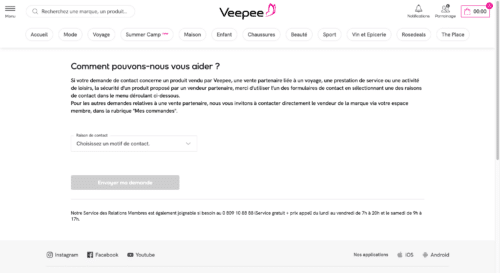
Although discreet, the presence of a telephone number on the Veepee website is reassuring and useful within the «Help & Contact» section. The addition of opening hours and call conditions further reinforces the perception that the service is reliable and trustworthy.
On mobile, make the phone number directly callably, readable and accessible to both keyboards and assistive technologies. A hidden, low-contrast or image-only contact does not fulfil its reassurance function.
Why are users still calling?
Users don't necessarily call because they prefer the phone to digital channels. They often call because what is online doesn't allow them to complete their process with enough certainty. A website might offer a comprehensive FAQ, a form and a personal account, but if the visitor doesn't understand which of these options corresponds to their situation, they won't feel empowered. They will look for the most direct channel to get a reliable answer: and very often they will choose the phone.
The search for a personalised answer
Users often choose the phone when they are looking for a personalised answer. An FAQ very often answers general questions. However, phone calls primarily stem from a personal question: «Does this rule apply to my case?», «What should I do now?», «Is it normal for my payment to be declined?». In these situations, the person is not necessarily looking for a long explanation. Above all, they want an answer situated in their context and a clear next step. This is particularly true when a deadline is approaching, an amount of money is at stake or a procedure seems irreversible. The more the perceived risk increases, the greater the need for a human exchange becomes.
The lack of visibility or information
Putting a service online is not enough to create user autonomy. To be truly autonomous, a user must be able to understand the goal, complete the action, verify that it has worked and know what will happen next.
A customer uploads a document to their account. If the interface does not confirm successful receipt of the document, fail to indicate processing times and do not specify the various procedures, then the user will call. The document has been submitted digitally, but the journey is not finished in the user's mind. The telephone then compensates for this lack of visibility.
Inadequate digital accessibility
A person using a screen reader, a keyboard, screen magnification software or voice control may encounter obstacles on digital media such as a website. These difficulties are not always taken into account in software design. In this case, the telephone acts as a fallback channel for some, but will never replace an accessible journey.
Contradictory channels
Inconsistencies between the different channels are another frequent cause of inbound calls. I call this situation a digital consistency debt the accumulation of information, rules and user journeys that are no longer aligned with one another. It is not each individual inconsistency taken in isolation that causes a problem, but their accumulation as perceived by the user.
A different price between the website and an email, different opening hours between Google and your contact page, a procedure announced by an advisor but absent from the customer area: these discrepancies generate calls and undermine trust.
A stumbling block in the process
A button that doesn't work on mobile, a form that rejects valid input, a login code that doesn't arrive or an attachment that cannot be uploaded all trigger direct calls. When the user can no longer proceed, the phone naturally becomes the quickest way to unblock the situation. These problems are sometimes invisible in traditional statistics, which is why advisers do not hesitate to document these blockages and pass them on to the development teams or Product Manager when it exists.
Can a chatbot replace a telephone number?
A chatbot can complement a phone number, but it cannot systematically replace it. A chatbot is particularly useful for guiding users, answering a frequent question or helping them find information. It is much less so when the request is complex, urgent, personal or unusual. The chatbot should be thought of as an aid along the journey, not as a barrier placed in front of the user to limit enquiries.
A conversational assistant brings value when it responds quickly to simple needs: finding an invoice, knowing which documents to provide, understanding a step, or being redirected to the right procedure. To be useful, it must deliver an actionable response. Saying «consult our FAQ» solves nothing if the chatbot has already understood the question. It must provide the relevant link, summarise the answer, and indicate the next step.
A chatbot also becomes counter-productive when it goes round in circles, gives irrelevant answers or prevents access to a person. The visitor then feels a dual frustration: their problem is not solved and they have to expend more effort to reach the company. Provide clear escalation to an advisor, a contextualised form or an appointment. Above all, pass on the history of the exchange. Asking a customer to repeat a situation they have already explained is a classic sign of a breakdown in the customer experience.
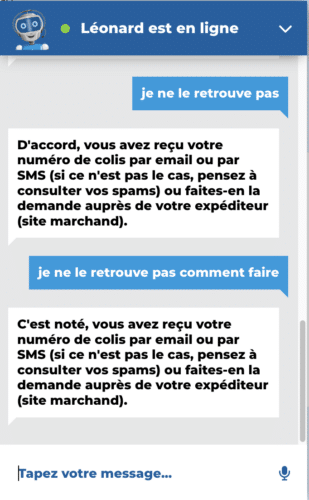
When a response does not meet the user's needs, Chronopost's AI assistant simply reformulates or repeats the same message, without offering an alternative.
Which phone calls are truly avoidable?
On a daily basis, what is truly frustrating for teams is when they feel that certain calls are avoidable. A call is genuinely avoidable when a user could obtain the same answer or perform the same action online with an equivalent level of confidence. The distinction is important: a short call, for instance, is not necessarily a pointless one. A prospect who calls before choosing a complex solution may legitimately need advice. Conversely, a customer who calls every week to check the status of their file is probably suffering from a lack of visibility that the digital journey could fix.
- Follow-up requests: «Where is my request at?», «Did you receive my document?», «When will I be reimbursed?», these calls are often avoidable, provided that online tracking is precise and reliable.
- Information requests that are already online: Public information does not mean findable: there are organisations where information is hidden under an unexpected heading, impossible to find via the search engine, phrased using professional jargon or buried in several paragraphs.
- Simple administrative tasks: Downloading an invoice, changing an address or rescheduling an appointment are tasks that a user should be able to carry out without calling. Self-service is something that must not be overlooked and must be genuinely usable. If simple administrative tasks are already perfectly usable, then naturally it will be the so-called more complex journeys that will keep advisors busy on the phone.
A phone number on a website is neither an archaism nor the sign of a flawed digital journey. It is a channel of trust that remains essential when the situation is complex or high-stakes.
Calls aren’t just enquiries to be handled. They often reveal missing information, a lack of visibility, an inconsistency between multiple channels or a blockage in the customer journey. Analysing them improves much more than just telephone support: the entire customer experience progresses.
The aim is therefore not to eliminate calls, but to ensure that every call brings real value to both the customer and the company.