

Launching a website with AI might seem like the ideal solution today: fast, inexpensive, accessible without technical skills. Numerous tools promise to automatically generate pages, text, a structure, and even a complete design in just a few minutes. This apparent ease meets a real need: to exist online quickly, test an idea, or produce a first support without mobilising too many resources.
However, a few months after a site is generated by AI, it often becomes more expensive to maintain than to operate. What was supposed to simplify an online presence gradually turns into a constraint. Each modification calls for another, each addition creates inconsistencies elsewhere. It becomes unclear why what seemed simple at the outset progressively becomes difficult to manage.
This paradox is neither an accident nor a misuse. It reveals a rarely anticipated structural mechanism: the progressive accumulation of a coherence debt.
What is consistency debt?
Accumulation of inconsistencies in a digital service, resulting from decisions taken without an overall vision. It manifests itself in fragmented experiences, contradictory messages and implicit rules that vary from page to page or channel to channel, making the service difficult to understand, use or trust. In the long term, it degrades the user experience, makes maintenance more cumbersome and slows down product development. See detailed definition.
Let's take a concrete example: a consultancy generates its site in October, the texts are correct and the layout acceptable. In December, the senior partner herself writes a «Our approach» page to better reflect the firm's positioning. In February, a new service is added via AI. In March, the blog was launched with articles written in-house. As a result, the site becomes a heterogeneous assemblage. Automatically generated pages sit alongside hand-edited content, language levels diverge and navigation logic becomes blurred. The promises made on the homepage no longer correspond to the content of the pages inside. In short, itineraries become incoherent.
Consistency debt accumulates mechanically, adjustment after adjustment, without us realising it at the time. By the time it's noticed, the consequences become visible and then spread throughout the entire organisation.
What are the limitations of automatic generation by AI?
Should this debt be attributed to AI? Not really, generative AI produces plausible content but not necessarily coherent at an organisational level. It has access neither to the strategic vision, nor to its editorial compromises, nor to its history. Automated generation is not based on an overall vision, but on The assembly of plausible content, without continuity with the strategic choices made over time.
Each modification made after the initial generation with the AI creates a discrepancy. And as the AI does not «remember» any of these adjustments, any new generation - an additional page, a blog post - starts again from the initial statistical model, without taking account of changes. What the AI produces is consistent locally, page by page, but rarely globally.
In this way, debt accumulates by ricochet: each new generation ignores previous corrections, forcing new interventions, which themselves call for other adjustments to maintain a minimum of overall coherence.
This debt remains invisible as long as the site is little used, but as soon as it becomes a genuine tool for brand awareness, traffic, conversions, or work, inconsistencies cease to be anecdotal.
A possible divide between online and real experience
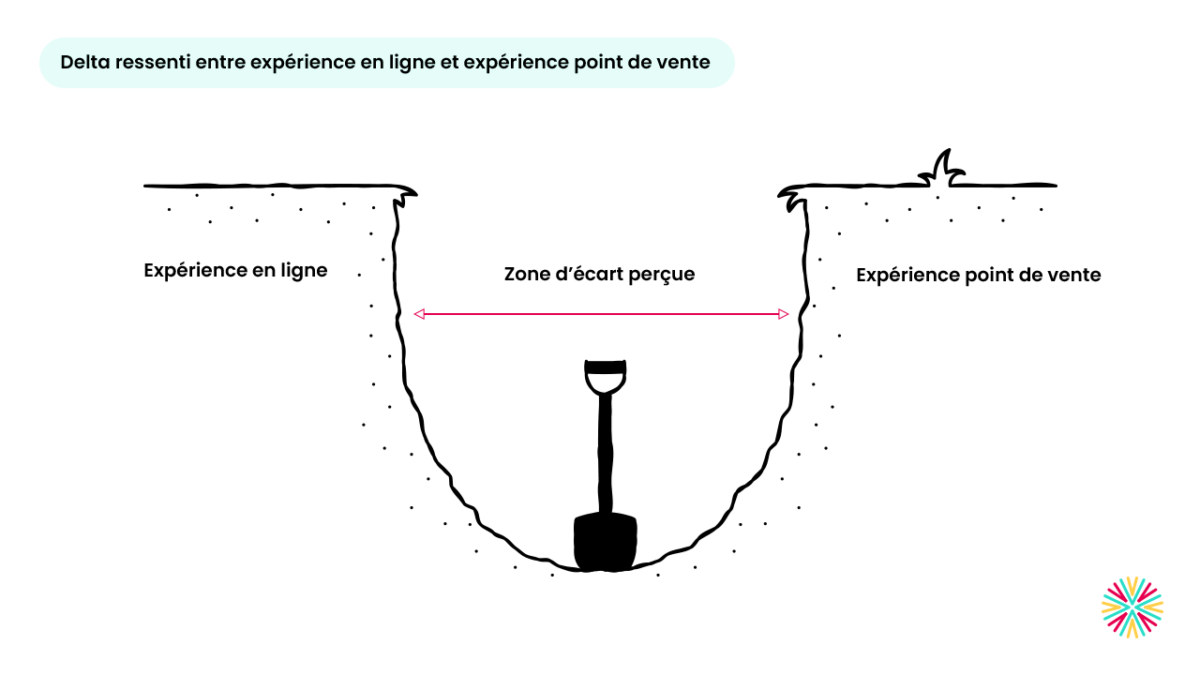
For organisations that combine a physical and digital presence, generating An AI-powered website can accentuate a divide between the online experience and the in-store experience. The user who discovers the AI-generated site, then walks through the door of the point of sale, is faced with two distinct brand identities. The tone is no longer the same, the promises no longer match, the attention to detail is different. What they read online does not prepare them for what they will experience in person, and vice versa.
The homogenisation of content linked to AI also poses another problem: it dilutes the uniqueness of an organisation and weakens its credibility. A website is a living interface between an organisation and people with different needs, doubts and contexts. The user experience is based on a detailed understanding of these intentions.
Creating a website in a few clicks can give the illusion of rapid progress. But a website is an interface between an organisation and its users. He makes choices, trade-offs and has a way of understanding needs. Without this structuring, content production remains superficial and difficult to manage over time.
The technical and structural impacts to anticipate
Over time, on sites generated entirely by AI, it becomes difficult to intervene without creating new imbalances. Modifying one page disorganises another, and adding content means reworking the whole thing to maintain logic. Some organisations end up calling for help to try and repair the structure, form and content - which, at At this stage, it is always costly and rarely fully satisfactory.
In addition to the impact on maintenance, the automatic generation approach generates other collateral damage. Take digital accessibility, It's an approach that runs through the whole design process. AI site generators often produce structures that appear compliant on the surface, but show inconsistencies as soon as they are tested with disabled users. These flaws are not obvious at first glance, but they exclude part of the audience and expose them to increasing legal risks.
As far as SEO is concerned, AI-generated sites produce surface-level technical SEO. They have not built up any editorial positioning: there is no reason for them to be quoted, shared or recommended. They don't generate qualified traffic, just traffic.
The same logic applies, an incoherent site attracts scattered traffic: visitors who are not always the right ones. Those who stay do not find a clear answer to their needs. Sometimes they fill in the contact form, but their expectations are unclear, out of sync or misinformed. Organisations spend time re-qualifying, re-explaining and re-framing. The website becomes a reverse filter: it attracts prospects who are not really aligned with the real offer.
Generative AI can be an accelerator Produce initial versions, explore avenues, quickly structure content.
But it doesn’t replace vision or the ability to make decisions. It guarantees neither consistency nor long-term relevance. A website isn't just a collection of pages. It's based on an overall logic, editorial continuity, and the ability to align content, user journeys, and intent. Without this structure, initial simplicity gradually gives way to complexity that is difficult to manage.