


In many networks – franchises, national chains, or multi-site groups – the question of local communication comes up regularly. Should you wait for head office decisions or let each point of sale develop its own digital presence? With social media, content creation tools, and artificial intelligence, these local initiatives have become simpler than ever.
How far should point-of-sale communications be allowed to go locally? Why is this phenomenon accelerating? How can communication consistency be maintained without stifling local initiatives?
In this article, discover why local pronouncements are multiplying, the risks they can generate, and the levers that allow for an articulation between local autonomy and global coherence.
Pourquoi les points de vente souhaitent-ils de plus en plus communiquer localement ?
For a long time, there were structural obstacles to digital communication. Creating a website took time, money, and technical skills. Opening a local social account required validation and support. These barriers didn't prevent initiatives but mechanically limited their expansion.
Today, the barriers to entry for communication have largely disappeared. Anyone - or almost anyone - can create a TikTok account in two minutes, publish content instantly and generate millions of views in just a few days, with no budget, no training and no validation. Multiplication becomes possible and AI is accelerating the trend. This technical facility creates a powerful illusion: that mastering a tool produces something effective, relevant, and coherent.
In organisations, these problems particularly affect teams not working directly on digital projects. They fail to see the technical, legal and reputational constraints. They underestimate the complexity and overestimate the speed with which things can be done.
Why do local teams underestimate the complexity of digital?
The global context and the disappearance of barriers to digital entry create a tension that is difficult for central teams to bear. On the one hand, they are expected to provide a framework, to harmonise and secure what is said. On the other, the tools available allow everyone to publish instantly, without validation. This discrepancy creates a profound misunderstanding: for local teams, the slowness of communications departments is incomprehensible. Creating an account, posting a video or following a trend can all be done in a few minutes, so why aren't we doing it?
Each local channel opening involves multiple questions from head office: what exactly are we saying, and on whose behalf? What tone do we adopt, and within what limits? How does this discourse relate to other channels? What happens in the event of a bad buzz, misuse, or sensitive comment? Who responds, who arbitrates, who takes responsibility?
As the global population becomes increasingly digitally literate, familiarity bias and the illusion of understanding are concepts that can help us to better understand the growing difficulties faced by IT, IS and communications teams.
The familiarity bias
Le familiarity bias, is the tendency to overestimate our competence in a subject because we use it on a daily basis and are familiar with it: social networks, online shopping, browsing websites, etc. We then confuse proximity of use with expertise.
The illusion of understanding
The illusion of understanding makes us think we have mastered a system until we have to explain or design it.

Case study: Leclerc Nîmes (2026). A local account causes a bad buzz on the occasion of Chinese New Year

Case study: Carrefour (2025) Léonie, a checkout assistant at a local Carrefour, launches a TikTok account about the behind-the-scenes workings of the store, which goes viral but also leads to heightened security measures for the young woman.
These issues require time, reflection and collective decisions. Not being present on a platform is not always a delay, it is sometimes a responsible choice. Some organisations don't go on TikTok because the expected tone is not compatible with their positioning, because the communication target is elsewhere, or because the human resources don't allow them to maintain the format over the long term. Absence can be a conscious choice, not a weakness.
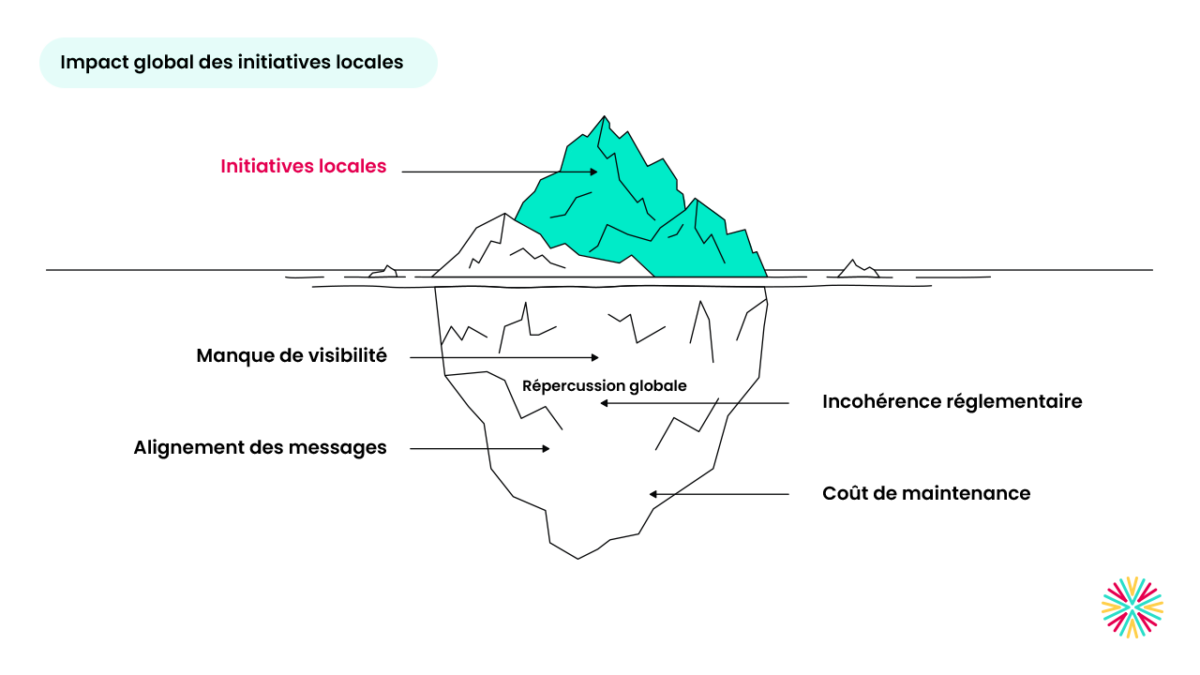
Local initiatives, however legitimate they may be, obscure these issues. They create the illusion that we are saving time because we are faster and more efficient (in terms of views, for example) than head office. In reality, they displace and create complexity. What seemed like a time-saving measure becomes a collective maintenance cost or an inconsistency in the overall communication strategy.
The risks of uncontrolled local communication include misinformation, reputational damage, and potential legal issues.
Conflicting information for customers
Each local site, each social page responds to a real need: taken in isolation, each seems relevant, but their accumulation forms an unstable system. A debt of consistency is gradually taking shape, linked to a local optimisation of what should have been thought out globally.
Let's take the example of a customer who visits a local pharmacy website advertising a teleconsultation service. He goes into the shop: the service no longer exists. On the national site, a different partnership is mentioned. Elsewhere, a national promotion is relayed differently on local social network pages, with different terms and dates. Customers no longer know what is valid where.
Differences in tone, message, promise, service, information system: taken in isolation, each difference seems insignificant. The accumulation of these discrepancies produces something much more serious for an organisation: foundations that are no longer under control, with repercussions for the overall customer experience.
A frequently underestimated maintenance cost
The local initiative always seems cheaper at first, but it is a trap. Creating a site yourself, subcontracting to a local service provider, rapidly launching an online presence without waiting for approval from head office - all of this sounds economical and pragmatic. But the real cost isn't in the initial production: it's in the maintenance, in the updates, in the redesigns, in the attempts to get back on track.
When a network decides to overhaul its visual identity, it has to pass on the change to all its local sites. When a regulation changes, all the sites have to be updated. But if nobody knows exactly how many there are, or who manages them, compliance becomes a legal headache. When a national strategy changes, you have to align messages across all channels. But if each franchisee has created its own digital ecosystem, no one can guarantee that the message will be properly relayed. What seemed to be a gain in local autonomy becomes a collective maintenance burden.
How can local and global digital projects coexist?
How far should we say yes to local initiatives? What approaches make it possible to balance local freedom and global coherence without accumulating debt?
Define a common framework
The first - and by no means least - solution is to set the framework and explicitly define the invariants What is it about the organisation's identity that cannot be varied locally? It could be the name, the logo, certain legal notices, the service promise or the tone on sensitive subjects. These invariants must be few in number, clear and justified. Everything else can be adapted. The whole must be distributed to the subsidiaries and supported by general management.
Supporting local initiatives
Secondly, if we want local teams to be able to communicate, we need to give them the means to do so without creating a debt of consistency. The other essential solution is therefore to equip decentralisation. This means having available and pre-configured IT and content systems, libraries of reusable content, simple user charters and short but regular training sessions. Autonomy does not mean total improvisation.
Organise feedback
And finally.., creating information feedback loops between local and global levels. Local teams see things that head office does not: their initiatives, even if they are not validated, reveal real needs. Rather than banning them, it can be useful to observe and analyse them and understand what they say about the organisation. Some local initiatives deserve to be generalised, while others reveal gaps in the central strategy.
Can we let the points of sale communicate freely?
Yes, on the condition that this freedom is part of a shared framework. The challenge is not to authorise or prohibit local initiatives, but to define what can be adapted and what must remain common to the entire network.
Unrestricted autonomy gradually leads to conflicting messages, variations in quality, and increased maintenance costs. Conversely, an overly rigid framework limits the ability of local teams to respond to the needs of their region. The balance lies in allowing freedom for local adaptations while preserving the brand's core elements.
There is no such thing as perfect consistency: in a network of 100, 200 or 500 sales outlets, there will always be gaps. The question is not to eliminate them all, but to decide which to accept and which to reject. This is a decision that must be explicit, shared and regularly reassessed. The real question is not whether local teams should be given freedom, but what level of consistency we are willing to sacrifice today and what the cost will be tomorrow.