


An image on a website can contain essential information. For assistive technologies used by blind or partially sighted people, this information only exists if it has been put into text. A screen reader, for example, reads what is written, not what is shown. This is the principle of image accessibility: to make visible, in the form of a textual description, what an image shows.
In many organisations, this information is neither systematically produced nor controlled. The accessibility of images then becomes random, dependent on contributors and difficult to maintain over time. The question is therefore not solely technical. It falls within the scope of editorial organisation and the rules that structure content production.
How to ensure the long-term accessibility of images? Why aren't best practices enough? How to integrate RGAA requirements into an organisation's editorial processes?
In this article, discover how to formalise image qualification rules, integrate them into publishing processes and ensure their long-term application.
Image alternatives in accessibility: what are they?
Image alternative (sometimes simply called «alt», after the HTML attribute used in the code) is the text alternative for an image. It is not normally visible by default but appears if the image fails to load, for example. Assistive technologies used by blind or visually impaired people, such as screen readers, other voice tools, and braille displays, enable this alternative to be presented if it exists. A correctly written text alternative allows them to access the image's content in the same way as other users.
The correct completion of these image alternatives is part of one of the many criteria for The General Accessibility Improvement Repository – which constitutes the applicable regulatory framework for public websites in France and a benchmark for many private organisations. A non-compliant criterion on this point may be sufficient to generate non-compliance in the context of an audit. An absent or poorly drafted alternative is not just a technical flaw: it can make information totally inaccessible and compromise understanding of the content.
Why and how to formalise image qualification in an organisation
Integrating an image into a digital interface involves several professions. at distinct stages: design, development, publication. However, none of these stages are subject to explicit responsibility for accessibility qualifications. Without a clear framework to guide these choices, practices can vary from one team to another and from one project to another. The same errors then progressively reappear, even after an audit or RGAA compliance. Without formalisation, accessibility relies on implicit decisions, which are rarely homogeneous and difficult to audit.
Raising team awareness of accessibility is a first step but insufficient to harmonise concrete decisions. Ensuring the long-term accessibility of images requires to structure editorial production and to formalise a shared framework between teams.
To formalise this shared framework, these rules can be integrated directly into CMSs, publishing interfaces or content templates.
In the majority of organisations, The decision of who should fill in the alt text for images remains implicit. This organisational ambiguity leads to recurring non-compliance, even after initial compliance phases.
Rules to define for image accessibility
For any type of image added by the content teams, the teams must be able to answer these three questions:
1- Is my image decorative or informative?
2- Si le texte alternatif est nécessaire : quel est le maximum number of characters for writing it and what information should it provide?
3- Are there any exceptions? If yes, when does the default rule not apply and provide examples. These documented exceptions prevent contributors from dealing with them on a case-by-case basis without a common reference.
Integrate these rules into the tools and processes
Formalising accessibility rules for images is a first step, but it doesn't guarantee their application over time. Their effectiveness depends directly on their integration into editorial production tools and practices.
In many organisations, these rules exist in documented form but are little used at the time of publication. They then rely on the individual vigilance of contributors, which introduces significant variability in the quality of the content produced.
The challenge therefore lies in moving these rules from a theoretical framework to an operational one. Several levers can structure this integration. Content management interfaces, for example, can enforce the input of alternative text or offer contextual help directly at the time of publication. Content templates can integrate explicit instructions, thereby limiting individual interpretations. Editorial validation processes can also include specific accessibility checkpoints.
This integration makes it possible to transform a one-off requirement into a production standard. Image accessibility no longer depends on isolated expertise but is part of a shared, repeatable, and controllable framework. Without this structuring, the rules remain theoretical and their application uncertain, even in organisations that have already begun compliance efforts.
How to apply accessibility rules according to the type of image?
These rules make perfect sense when applied to concrete cases, in connection with the types of content actually produced. The challenge is not to memorise general principles, but to know how to translate them operationally according to editorial contexts.
The following examples illustrate the most frequent situations encountered in organisations. For each, the expected treatment is specified to enable clear and consistent application by teams.
The news images
In a list of items – news, resources, events – each entry generally includes an image, a title, and a summary. The default rule could be that these images are decorative. The title and summary are sufficient to understand the subject, and the image serves a visual appeal function without providing additional information.
The exception applies when the image bears information absent from the text: a photograph identifying the location of an event not mentioned in the title, a visual showing a result or a state that the text does not describe.
The rule to be documented could be phrased as follows: «Images in news lists are decorative, unless they provide information – a place, person, or outcome – that the headline and summary do not mention.»
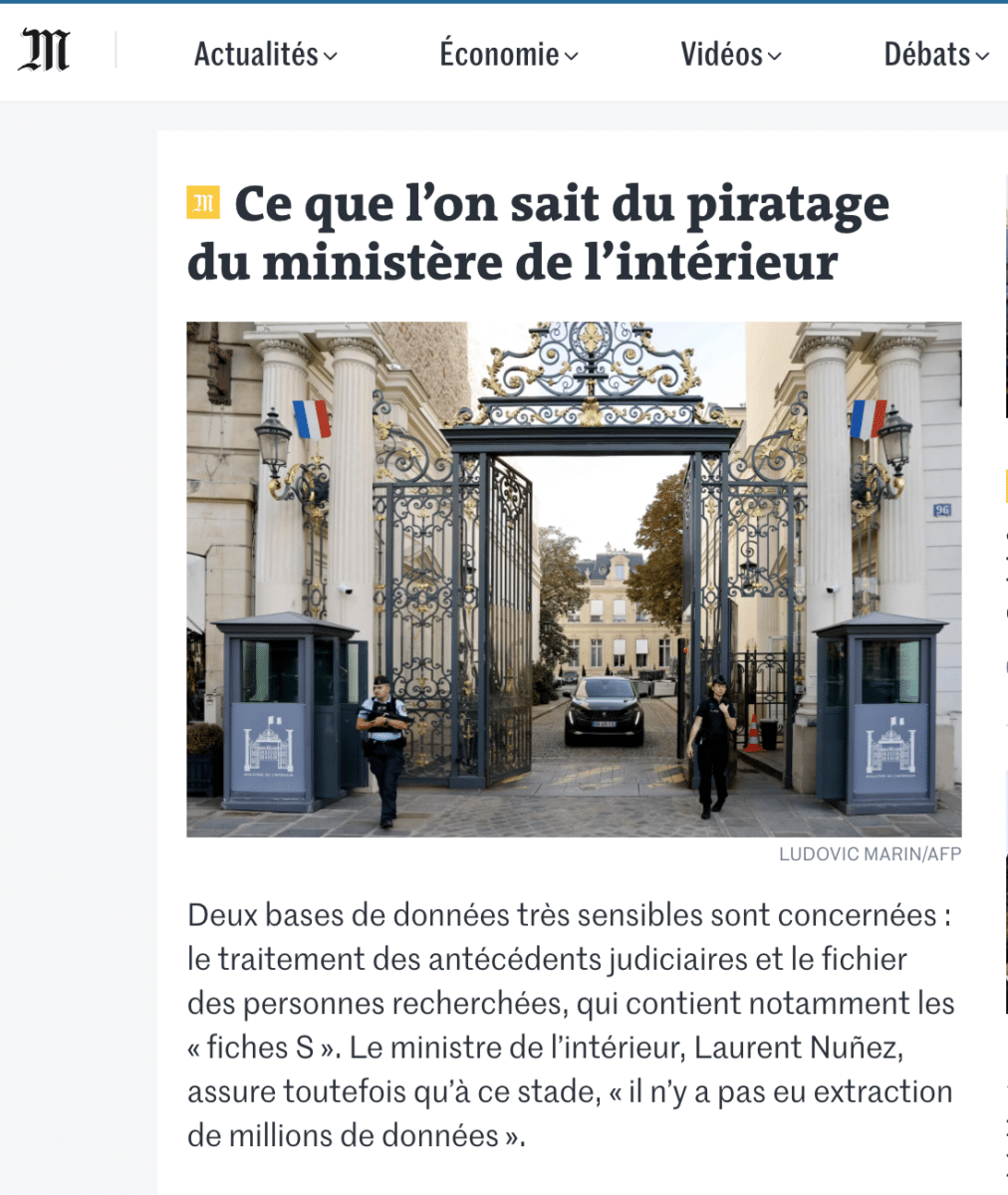
Illustrative photo of a news article about the hacking of the Ministry of the Interior, not requiring an alt tag.
Institutional pages
Atmospheric, staging, or visual background images are generally decorative.
Identified portraits (team, speakers, partners) are informative and should identify the person depicted, provided this information is not already supplied by adjacent text.
The product sheets
In the context of product sheets or detailed content pages, images often play a direct informational role: they show a detail, illustrate a step, or identify an element that the text alone cannot adequately describe. The default rule is therefore inverted: these images are informative until proven otherwise.
The alternative text should express what the image specifically contributes. For a product sheet, the alternative text should not repeat the product name – already present in the title – but can specify the angle, the colour, the visible detail that justifies the presence of this image rather than another.
Example of a product sheet
In this example from the Westwing website – an e-commerce site for decoration and furniture – a plate with a foliage print is offered for sale. The pattern is not mentioned in the product description text, nor in the alt text of the images.
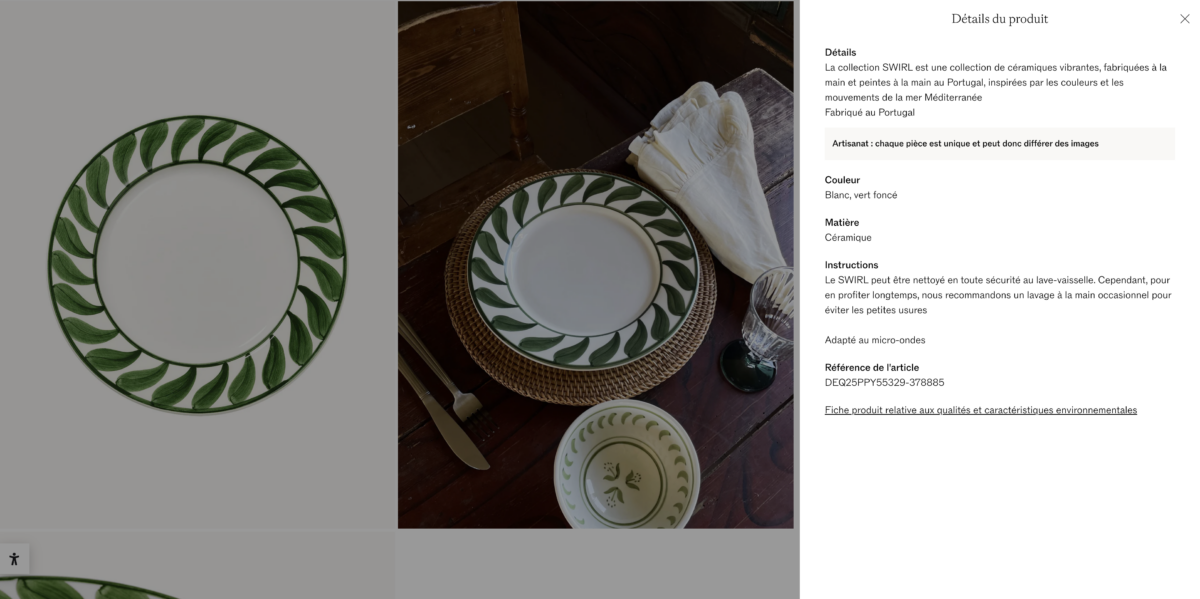
The pattern of the plate is not specified in the description text. Only the colours White and Dark Green are announced.
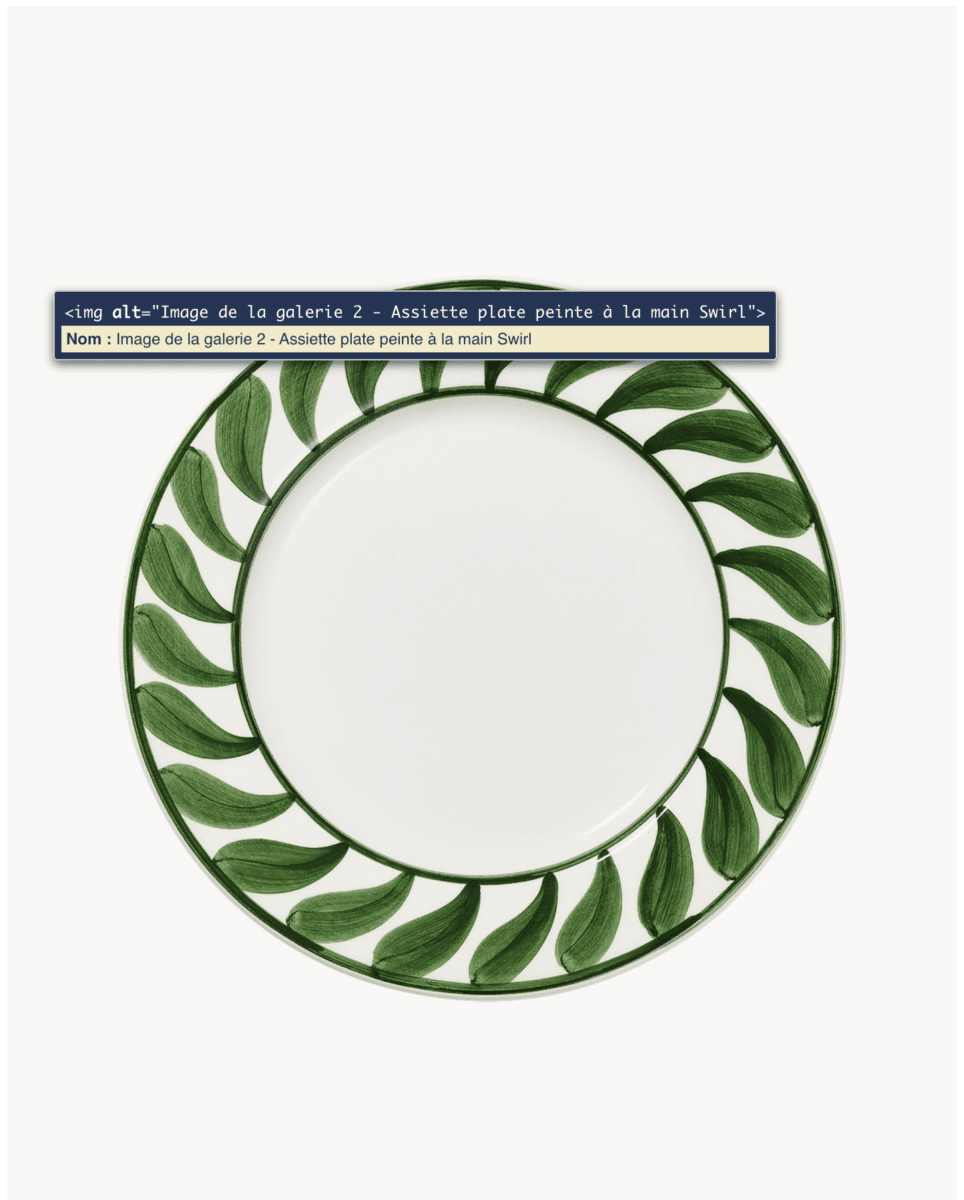
The alternative text provided is «Image of gallery 2 – Hand-painted Swirl dinner plate». The foliage-inspired pattern – information absent from the description text and the image alt – is therefore not conveyed to users of assistive technologies.
The icons
When an icon is alone in an interactive element, it is informative and should describe the action. When visible text accompanies the icon, it is decorative. The tricky case is the «new window» or «external link» pictogram: if the link text does not mention that it opens in a new tab, the pictogram becomes informative.
This rule must be made explicit for teams publishing content with outgoing links or downloadable documents.
The logos
A logo identifies a brand or organisation. The alt text is the brand name, not the word «logo». The exception applies when the brand name is already written out in full in close proximity – in this case, the logo can be treated as decorative to avoid redundancy.
Computer graphics
Infographics and data visualisations are almost always informative, but their alt text is often written as a visual description («bar chart showing data»). Alt text should convey the main conclusion or piece of information the image is intended to communicate. If the infographic is complex, long text below the infographic or a description in the form of an aria-describedby (structured alt text) may be necessary.
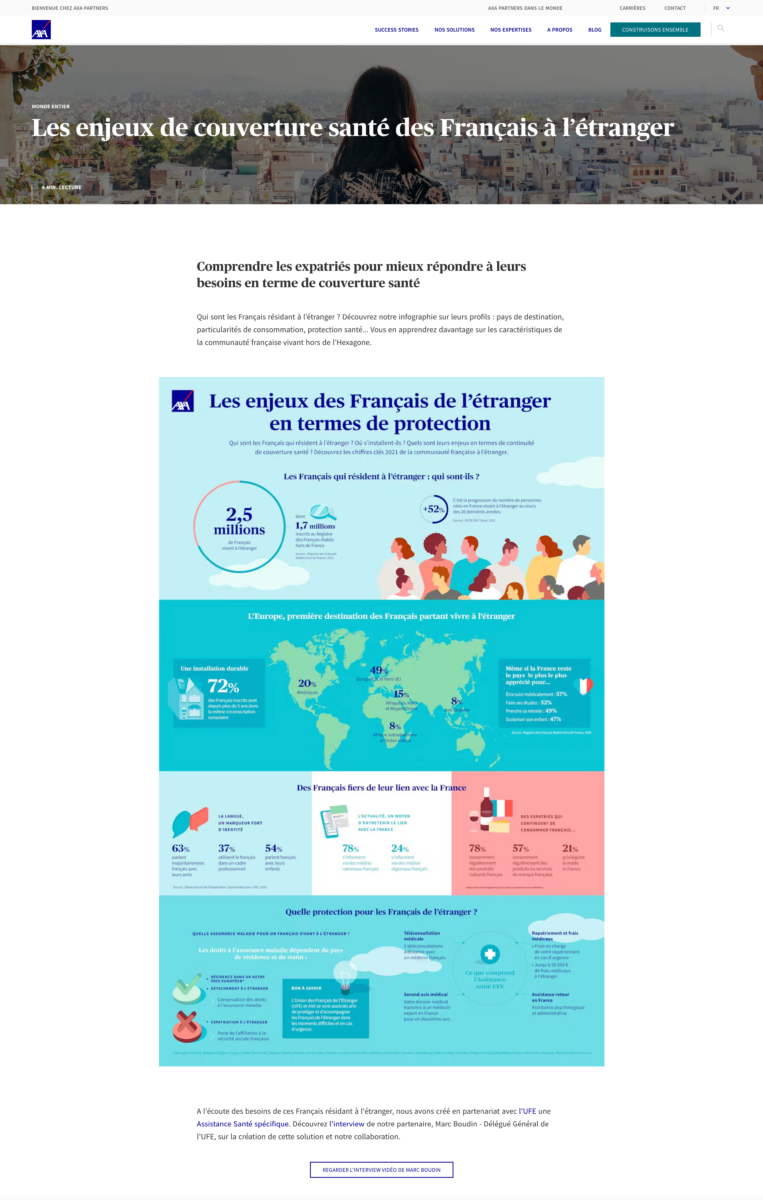
Example: Infographic with statistics. An aria-describedby will be necessary to convey all the information present in this image, otherwise a textual description beneath the infographic.
Why do organisations lose compliance over time?
Most compliance processes begin with an audit or a remediation project. However, a few months later, new non-conformities often appear. Teams change, new contributors publish content, tools evolve, and rules are gradually forgotten or interpreted differently.
Maintaining compliance therefore isn't just about correcting what already exists. It involves defining production rules, integrating them into tools, and regularly checking their application. Without this organisation, the same errors will gradually reappear.
RGAA compliance for images cannot be maintained over time without a structured framework: it relies on explicit rules, integrated into tools and shared by the teams that produce content on a daily basis.
Without a formal framework, the response varies depending on the speakers, constraints, and priorities. An editorial guide helps to stabilise these decisions and to integrate accessibility into production processes. The accessibility of images then ceases to be a one-off fix, but becomes an editorial standard fully integrated into content production.